
Passive AI Print on Demand Automation: Start Your Shop in 2026

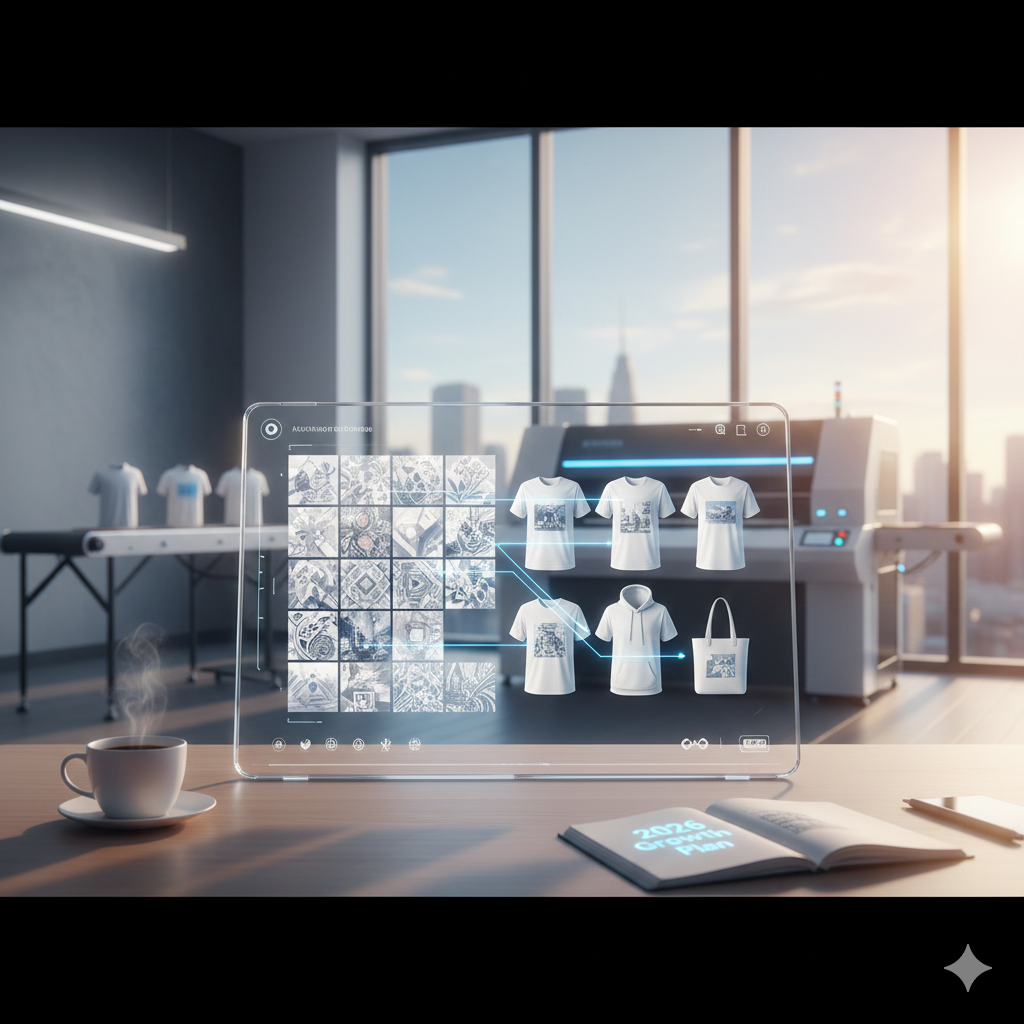
Passive AI Print on Demand Automation: Start Your Shop in 2026
The dream of running a profitable e-commerce business used to involve a mountain of manual labor: hours spent in Photoshop, tedious product uploads, and the constant stress of inventory management. However, in 2026, the landscape has fundamentally shifted. We are now living in the golden age of the “Invisible Store”—a model where AI print on demand automation handles everything from the first pixel of a design to the final shipping notification.
If you have ever felt overwhelmed by the technical hurdles of starting an online shop, you are in the right place. The barrier to entry has evaporated. With the right stack of autonomous workflows, you can now launch a brand that scales globally while you focus on the only thing that truly matters: high-level strategy. This isn’t just about “using AI”; it’s about building a self-sustaining ecosystem of digital real estate that works 24/7.
In this comprehensive guide, we are going to break down exactly how to leverage AI print on demand automation to build a semi-passive income stream that rivals traditional full-time businesses. From mastering Midjourney designs to optimizing your Etsy SEO with agentic intelligence, this is your blueprint for e-commerce success in 2026.
🔹 The “Invisible Store”: Why 2026 is Different
The traditional Print on Demand (POD) model of 2020 was revolutionary because it removed inventory risk. But it was still labor-intensive. You still had to be the designer, the copywriter, and the SEO specialist. In 2026, agentic AI has stepped in to fill those roles.
From Manual Design to Generative Genius
Previously, you needed a graphic designer or a subscription to expensive asset libraries. Today, tools like Midjourney v7 and Adobe Firefly produce high-resolution textures and complex illustrations in seconds. The cost per design has dropped from $50 (outsourced) to fractions of a cent.
The Power of Semi-Passive Revenue
By integrating Shopify automation with AI design engines, you create a “Profit Loop.” Once your store is configured, the AI can identify viral trends, generate matching designs, and push them to your storefront without you ever touching a mouse. This is how you transition from a “side hustle” to a genuine source of semi-passive revenue.
🔹 The Core Tech Stack for AI Print on Demand Automation
To automate your shop, you need a “Digital Staff” of tools that talk to each other. Here is the ultimate 2026 configuration:
| Tool Category | Recommended Platform | Role in the Automation Loop |
| Design Engine | Midjourney v7 / Kittl | Generates unique, high-conversion visual assets. |
| E-commerce Hub | Shopify or Etsy | The storefront where customers browse and buy. |
| Fulfillment | Printify or Printful | Handles printing, packing, and global shipping. |
| SEO Optimizer | Sale Samurai / Alura | Automates keyword research and listing descriptions. |
| Workflow Manager | Make.com or n8n | The “Glue” that connects your design tools to your shop. |
🔹 Step 1: Mastering AI Design Strategy
The biggest mistake beginners make with AI print on demand automation is thinking that “any” design will sell. In a market flooded with AI art, quality and niche-relevance are your only defenses.
Creating Viral Midjourney Designs
Don’t just prompt for “a cat on a shirt.” You need to understand the nuances of 2026 aesthetics. Use styles that are currently trending in home decor and apparel, such as:
Hyper-realistic textures: Think embroidery-style graphics or oil-painted landscapes.
Minimalist vector art: Perfect for the “clean aesthetic” dominating TikTok and Pinterest.
Glitchcore and Retro-Future: Using depth-map prompts to create visuals that pop off the product.
High-Resolution Textures and Upscaling
Print quality is the difference between a 5-star review and a refund. AI generators often produce images at 72 DPI, which is too low for a t-shirt or poster. You must include an automated “Upscaling” step in your workflow using tools like Topaz Photo AI or Leonardo’s Universal Upscaler to ensure your designs have the high-resolution textures required for professional printing.
🔹 Step 2: Setting Up the Automation Loop
This is where the magic of AI print on demand automation happens. Instead of manually uploading every shirt, you build a pipeline.
Trend Scouting: Use an AI agent to scan Pinterest, TikTok Shop, and Instagram for rising aesthetics.
Batch Generation: Your agent sends those trends to Midjourney to generate 50 unique variations.
Automatic Background Removal: Using AI-powered APIs, the background of every image is stripped away, leaving a clean PNG for printing.
Bulk Listing: The designs are pushed to Shopify automation apps or Etsy integrations that create mockups and product descriptions instantly.
🔹 Step 3: Dominating Etsy SEO and Shopify Traffic
A store with 1,000 products is useless if nobody sees them. Automation must extend to your marketing.
Etsy SEO at Scale
On Etsy, your success lives or dies by your tags and titles. In 2026, the algorithm favors “Human-centric” titles over keyword stuffing. Use AI tools to:
Generate Long-tail keywords based on real-time search volume and gifting trends.
Write descriptions that incorporate LSI keywords naturally to build trust with both Google and Etsy.
Auto-update your shop’s categories based on seasonal shifts (e.g., from “Winter Decor” to “Spring Accents”).
The Shopify Automation Edge
If you are running your own site, you aren’t limited by a marketplace algorithm. You can use AI to manage your drop-shipping ads, automatically adjusting your budget based on which designs are getting the most “Add to Carts.” This ensures you are only spending money on winners, maximizing your semi-passive revenue.
🔹 Common Mistakes to Avoid in 2026
Ignoring Copyright: AI-generated images are a legal gray area in some regions. Always use tools that offer commercial-use licenses (like Midjourney’s Pro plan) and check for trademarked phrases in your text.
Low-Effort Descriptions: Don’t let your AI write robotic text. Use “Humanizer” prompts to ensure your product stories resonate with buyers.
Poor Mockups: Customers buy with their eyes. Use AI to generate “lifestyle” mockups that show your products in beautiful, realistic settings rather than plain white backgrounds.
🔹 Expert Insights: The Future of POD
The most successful “Digital Landlords” of 2026 aren’t the ones with the most designs; they are the ones with the most efficient autonomous workflows. The goal is to spend your time improving the system, not doing the work. As AI models become more multimodal, we are seeing agents that can generate a design, record a promotional video for it, and post it to social media—all without human input. This is the ultimate end-game for AI print on demand automation.
🔹 FAQ: AI Print on Demand Automation
How much does it cost to start an AI POD shop in 2026?
You can start for as little as $50/month (covering a Shopify plan and a Midjourney subscription). Most tools offer “Pay-as-you-go” API models, so your costs only scale when your sales do.
Is AI Print on Demand Automation truly passive?
It is “Semi-Passive.” You need to spend about 2–4 hours a week checking on your systems, responding to unique customer queries, and refining your prompts for the next season.
Which is better: Shopify or Etsy?
Etsy is better for beginners because it has built-in traffic. Shopify is better for scaling because you own the customer data and have more powerful Shopify automation options.
How do I ensure my designs are high-resolution?
Always use an AI upscaler. High-resolution textures are critical; your print files should ideally be 300 DPI at the final print size to avoid pixelation.
Can AI write my Etsy SEO tags?
Absolutely. Tools like Sale Samurai now have built-in AI generators that analyze the top 10% of performers in your niche and suggest tags based on their success.
Does AI help with customer service?
Yes. You can integrate AI chatbots like Tidio or Zipchat into your Shopify store to handle 90% of common questions regarding shipping times and order tracking.
What are “Profit Loops”?
A profit loop is a system where the revenue from one sale is automatically reinvested into the automation (ads or design credits) to generate the next sale, creating a self-sustaining cycle.
How do I handle international drop-shipping?
Use a global fulfillment partner like Printify. They have printing hubs in the US, EU, and Asia, meaning your AI print on demand automation setup can serve customers worldwide with local shipping rates.
🔹 Conclusion: Your Path to E-commerce Freedom
The transition to AI print on demand automation is no longer a luxury; it is a competitive necessity. By building your shop on a foundation of autonomous workflows, you free yourself from the grind of manual labor and open the door to true scalability.
Remember, the technology is just the tool. Your success comes from your ability to spot trends, connect with a specific audience, and orchestrate these powerful AI agents to work in harmony. The “Ghost Business” of 2026 is waiting for you to build it.
📢 Affiliate Disclosure
We believe in transparency. To keep our high-level SEO research free for everyone, this post contains an affiliate link. If you click through and make a purchase, we may receive a small commission at no additional cost to you. We only recommend tools that have been rigorously tested within our own 2026 automation loops.
🏆 Ready to Automate Your Empire?
The biggest barrier to a successful shop is the “Startup Friction”—the weeks spent trying to get tools to talk to each other. You don’t have to do it alone. You can bypass the learning curve with pre-built automation templates, “Viral Design” prompts, and the exact SEO roadmap used by the world’s top 1% of POD sellers. If you are ready to launch your automated shop in record time, you can access the “POD Automation Mastery” 2026 Blueprint here. This is your fast-track to e-commerce freedom.








 WordPress Plugins